

One Hour From the Strip, a Million Miles From Everything Else
You’ve been in Las Vegas for two days. Your feet ache from miles of casino carpet. Your eyes are adjusting to the permanent twilight of slot machine floors. And somewhere between your third buffet and that cocktail you probably didn’t need, a thought creeps in: *what would fresh air feel like right now?*
Fifty miles northeast of the Strip, there’s a place where 150-million-year-old sandstone glows so intensely red it looks like the earth itself is blushing. No slot machines. No crowds elbowing past you on the sidewalk. Just ancient rock formations, desert silence, and the kind of wide-open sky that makes you remember why you have lungs.
That place is Valley of Fire State Park, and it is, without exaggeration, the single best day trip you can take from Las Vegas.
What Makes Valley of Fire So Special
Valley of Fire isn’t just “a park near Vegas.” It’s Nevada’s oldest state park, established all the way back in 1935, and its largest at roughly 40,000 acres. The name comes from the red Aztec sandstone formations that dominate the landscape. When sunlight hits them (especially at sunrise or late afternoon), the rocks genuinely look like they’re on fire. Reds, oranges, pinks, and purples shift and change as the light moves across the sky.
And here’s the part that surprises most people: this place is closer than the Grand Canyon. Way closer. While a South Rim trip eats your entire day (and often your entire wallet), Valley of Fire sits just an hour from your hotel. You can sleep in, drive out, explore for four or five hours, and still be back on the Strip for dinner reservations. The park entrance fee? Just $15 for your whole vehicle. That’s everyone in the car, covered.
The park is also home to petrified wood, ancient petroglyphs dating back thousands of years, and rock formations with names like Elephant Rock and the Beehives that look exactly like they sound. It’s the kind of place where you’ll burn through your phone’s storage on photos before you’ve been there an hour.

The Must-See Stops (Your Valley of Fire Route)
The beauty of Valley of Fire is that you don’t need to be a serious hiker to enjoy it. Some of the best spots are right off the road, and the trails that do exist are short, well-marked, and absolutely worth the effort. Here’s how to hit the highlights, roughly in order as you drive through the park.
Elephant Rock: Your First “Wow” Moment
Pull over near the east entrance and take the short walk to Elephant Rock, a natural sandstone arch that looks remarkably like an elephant with its trunk reaching toward the ground. It’s a quick stop (ten minutes, tops), but it sets the tone for everything that follows. This is also one of the most photographed spots in the park, so get your camera warmed up early.
Atlatl Rock and the Ancient Petroglyphs
A metal staircase leads you up to a massive sandstone boulder covered in petroglyphs carved by native peoples thousands of years ago. The most famous carving depicts an atlatl, a prehistoric spear-throwing tool, etched into the rock face roughly 40 feet above the desert floor. Standing up there, looking out over the landscape and then back at symbols left by someone who stood in the same spot millennia ago, is one of those moments that puts your casino losses in perspective.
For more petroglyphs, take the easy walk along the Mouse’s Tank Trail. This half-mile path follows a sandy canyon to a natural rock basin where rainwater collects (named after a Southern Paiute renegade who used the area as a hideout in the 1890s). The canyon walls on either side are covered in petroglyphs, and the flat, shaded terrain makes it one of the most comfortable walks in the park.
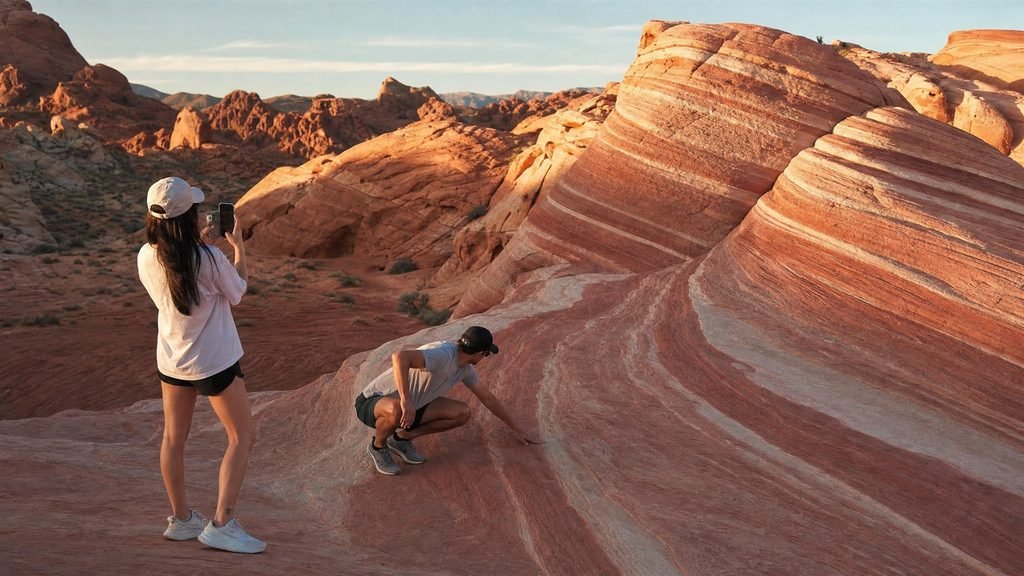
Fire Wave: The Showstopper
If you only have time for one hike, make it this one. The Fire Wave Trail is about 1.5 miles round trip and takes roughly 45 minutes to an hour. The payoff is a swirling, undulating formation of pink, white, and red sandstone that looks like a frozen ocean wave made of candy. The bands of color curve and flow in patterns that seem too perfect to be natural. Early morning and late afternoon light turn the colors up to eleven.
The trail itself is moderate. You’re walking across open desert and slickrock with minimal shade, so bring water and wear a hat. But the distance is short and the terrain is manageable for most fitness levels.
Important: Fire Wave Trail is closed annually from May 15 through September 30 due to extreme heat. Summer temperatures in the park regularly exceed 110 degrees Fahrenheit, and this exposed trail offers zero shade. The closure is for your safety, and park rangers enforce it.
White Domes Trail: Slot Canyons and Movie History
Just 1.1 miles as a loop, White Domes packs an absurd amount of scenery into a short walk. You’ll pass through a narrow slot canyon with towering walls, walk past the ruins of a set from the 1966 Western film The Professionals, and see a striking contrast between white sandstone formations and the fiery red rock Valley of Fire is known for. The whole loop takes about 45 minutes and delivers some of the most dramatic photo opportunities in the park.
Important: White Domes is also closed May 15 through September 30 along with Fire Wave and several other trails.
Rainbow Vista: The View Without the Walk
Not every great view requires a hike. Rainbow Vista is a panoramic overlook right off the main road, offering sweeping views of multicolored rock formations stretching toward the horizon. It’s a perfect spot to stretch your legs, snap some photos, or set up a picnic lunch with a view that most restaurants would charge you $200 for. Accessible year-round, no hiking required.
The Scenic Drive Itself
Even if you never leave your car (though you absolutely should), the drive through Valley of Fire is worth the trip on its own. Mouse’s Tank Road winds through the heart of the park with pulloffs at every scenic point. Red, orange, and purple rock walls rise on both sides of the road, and the landscape changes constantly. For anyone traveling with someone who isn’t into hiking, or on a scorching summer day when the trails are closed, the scenic drive still delivers.
When to Go: Timing Your Visit Right
October through April is the sweet spot. Temperatures are comfortable for hiking (60s to 80s most days), all trails are open, and the lower sun angle makes the rock colors even more vivid.
Summer (May through September) is a different story. Daytime highs regularly blast past 110 degrees Fahrenheit. Most of the best trails are closed for safety, and even short walks in that kind of heat can be dangerous. You can still visit for the scenic drive and quick roadside stops, but you’ll want to arrive early in the morning and keep your expectations realistic.
Time of day matters too. Early morning gives you the coolest temperatures and golden light that makes the red rocks practically glow. Late afternoon and sunset are equally magical for photography. Midday light tends to wash out the colors and comes with the hottest temperatures, so plan around it when you can.
Weekdays vs. weekends: Valley of Fire gets noticeably less crowded on weekdays. If your Vegas schedule is flexible, a Tuesday or Wednesday visit means fewer people at the popular trailheads and easier parking.
Getting There (It’s Easier Than You Think)
From the Strip, take I-15 North for about 35 miles, then exit onto Highway 169 East. Follow that straight into the park. Total distance: roughly 50 miles. Total drive time: about an hour, depending on where your hotel is. Plug “Valley of Fire Visitor Center” into your GPS and you’re set.
Gas up before you leave. There are no gas stations inside the park and nothing for miles around it.
Download your maps before you go. Cell service vanishes once you enter the park. Download offline Google Maps for the drive and grab the AllTrails offline maps for any hikes you’re planning. Don’t count on a live signal for anything once you’re there.

Don’t Want to Drive? Book a Guided Tour
If you’d rather skip the rental car or want a guide pointing out things you’d walk right past, several well-rated small-group tours run daily from Strip hotels. A guide adds real value here since there’s no cell service in the park and it’s easy to miss stops without local knowledge.
Small Group: Valley of Fire Half Day Tour
The best all-around option. This six-hour tour includes hotel pickup and drop-off, a deli lunch, snacks, water, park admission, and a professional guide who hits all the highlights: Beehive Rock, Atlatl Rock, Seven Sisters, Rainbow Vista, Fire Canyon, Elephant Rock, and Fire Wave. Max 13 travelers per group. You’re back at your hotel by mid-afternoon with the rest of your Vegas day still ahead of you. ~$99/person | 5.0/5 rating from 3,000+ reviews on Viator.
Book the Valley of Fire Half Day Tour on Viator →
Valley of Fire 3-Hour ATV Tour
The adventure pick. If walking trails aren’t enough adrenaline, this tour puts you on an ATV tearing through sand washes, rocky desert trails, and red sand dunes with those massive rock walls rising around you. The total experience runs about 5.5 hours (with 3 hours of actual ride time), and includes hotel pickup, all safety gear and training, lunch, and park admission. You’ll need to be 18+ with a valid driver’s license, and there’s a $300 refundable deposit per ATV. ~$199/person | 4.5/5 rating on Viator.
Book the Valley of Fire ATV Tour on Viator →
Valley of Fire and Hoover Dam Day Trip
The two-for-one pick. If you only have one day for excursions, this full-day tour (9 to 10 hours) knocks out Nevada’s two biggest must-sees in a single outing. You get the red rock drama of Valley of Fire in the morning (Fire Wave, Elephant Rock, Beehives, Mouse’s Tank) and a guided walk across the top of Hoover Dam after lunch, with panoramic views from the memorial bridge. Max 14 guests, with hotel pickup, lunch, unlimited snacks and drinks, and all admissions included. ~$119/person
Book the Valley of Fire & Hoover Dam Day Trip on Viator →

What to Bring
The park has almost nothing for sale inside it. Come prepared:
- Water: At least one liter per person per hour if you’re hiking. The Visitor Center is the only refill spot in the entire park.
- Food: Pack snacks and lunch. There are no restaurants, cafes, or food trucks inside the park.
- Sun protection: Sunscreen, a hat, and sunglasses are non-negotiable. There is very little natural shade.
- Closed-toe shoes: The terrain is rocky and uneven. Sandals and flip-flops are a recipe for a twisted ankle.
- Fully charged phone with offline maps downloaded: You will not have cell service. Download Google Maps and AllTrails maps at your hotel before you leave.
- Camera: Your phone works great, but whatever you bring, make sure you have plenty of storage. You’ll use it.
- Light layers (October through March): Desert mornings can be surprisingly chilly. A hoodie or light jacket will be your best friend at sunrise.
What It Costs (Spoiler: Almost Nothing)
Valley of Fire is one of the most affordable day trips you can take from Las Vegas, which makes it even more criminal that more people don’t go.
| Expense | Cost |
|---|---|
| Park entry (out-of-state vehicle) | $15 |
| Park entry (Nevada residents) | $10 |
| Park entry (bicycle) | $2/bike |
| Camping (out-of-state, per night) | $25 |
| Gas (round trip from Strip, ~100 miles) | ~$10-15 |
For $15, your entire carload gets into the park. Compare that to a Grand Canyon bus tour at $300+ per person or a helicopter tour north of $500, and Valley of Fire starts to feel like the best deal in a city that’s famous for deals.
If you’re driving yourself, your total cost for the day (gas plus entry) comes in under $30. Bring your own food and water, and you’ve got a full day of jaw-dropping scenery for less than the price of one overpriced cocktail at a rooftop pool.
Go. Seriously, Just Go.
Here’s the thing about Valley of Fire: almost everyone who visits says the same thing afterward. “I had no idea anything like that existed so close to Vegas.” The photos are stunning, sure. But standing in the middle of that landscape, surrounded by rock that’s older than anything your brain can really comprehend, feeling the desert quiet settle in after days of casino noise? That’s the part you can’t capture in a picture.
You don’t need to be a hiker. You don’t need to be outdoorsy. You don’t need special equipment or a full day. You just need a car (or a tour bus), some water, and the good sense to step away from the blackjack table for a few hours.
Valley of Fire is waiting, and it’s only an hour away.