Red Rock Canyon, Ancient Petroglyphs, Alpine Forests, and Desert Springs, All Less Than 90 Minutes From the Strip
You’re standing at a floor-to-ceiling window on the 30th floor of your hotel, cocktail in hand, looking out at miles of flat, brown desert stretching toward the mountains. And you’re thinking: there’s nothing out there.
You could not be more wrong.
That desert you’re staring at? It’s hiding some of the most jaw-dropping natural landscapes in the American West. We’re talking 600-million-year-old sandstone formations that glow like they’re on fire. Petroglyphs carved by people who lived here thousands of years before the first casino chip was ever made. A mountain where you can build a snowman in the morning and be poolside by lunch. Crystal-blue springs in the middle of absolute nowhere, filled with fish that exist in exactly one place on Earth.
The wildest part? Almost all of it is less than an hour from your hotel room. Some of it is fifteen minutes away. And most of it costs less than a single Strip cocktail to visit.
So lace up some decent shoes, fill a water bottle, and let’s go find the Las Vegas that nobody puts on a postcard.
The Famous Ones (That Deserve a Second Look)
You’ve probably heard of these. You might even have them on your itinerary already. But most visitors barely scratch the surface, so here’s what you’re actually missing.
Red Rock Canyon: Way More Than a Scenic Drive
20 minutes from the Strip | | Timed reservations required Oct-May
Everyone does the 13-mile scenic loop. And yes, it’s gorgeous. Those massive Aztec sandstone cliffs shifting from cream to crimson as the road winds through the canyon? Absolutely worth the drive. But if you only do the loop, you’re seeing Red Rock Canyon the way you’d see Paris from a tour bus window.
Get out of the car.
The Calico Tanks Trail is the move for most visitors. It’s about 2.5 miles round trip, moderately challenging with some scrambling over boulders, and it ends at a natural rock basin with a view of the entire Las Vegas valley spread out below you. On a clear day you can see the Strip shimmering like a mirage in the distance. It’s the kind of photo that makes your friends text you immediately.
Here’s an insider move: skip the main entrance entirely and head to Calico Basin, a free-access area just outside the scenic drive gate. Same stunning red rock formations, zero entry fee, and a fraction of the crowds. You can hike from here into some of the same trail networks without paying a dime.
Pro Tip: Show up at sunrise. Not “early morning.” Sunrise. The rocks turn colors you didn’t know existed in those first thirty minutes of light, the parking lots are empty, and the temperature is actually pleasant. During peak season (October through May), you’ll need a timed reservation through Recreation.gov to enter the scenic drive between 8 a.m. and 5 p.m. Beat the system by arriving before 8 or after 5, when no reservation is needed.
Keep your eyes on the rocky slopes above you. Red Rock Canyon is home to a healthy population of desert bighorn sheep, and spotting a group of them navigating an impossibly steep cliff face is the kind of moment that rewires your whole opinion of the desert.
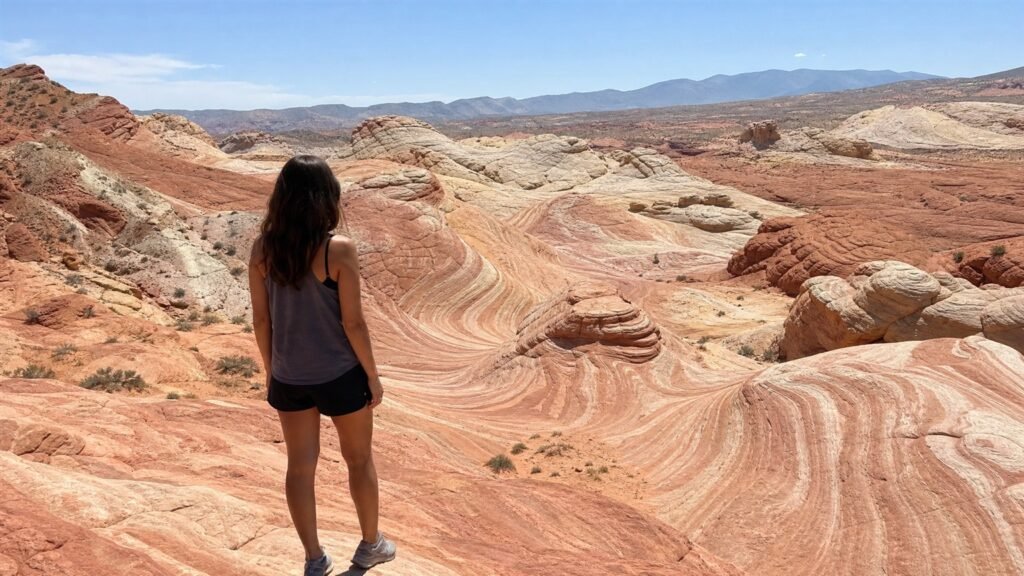
Valley of Fire: Nevada’s Oldest State Park Looks Like Mars
1 hour from the Strip | | No reservation required
If Red Rock Canyon is the appetizer, Valley of Fire is the full entree with dessert. Nevada’s oldest and largest state park covers over 40,000 acres of Mesozoic-era sandstone, and the colors are so vivid they look photoshopped. Reds, oranges, purples, and pinks swirl together across formations that took 150 million years to sculpt.
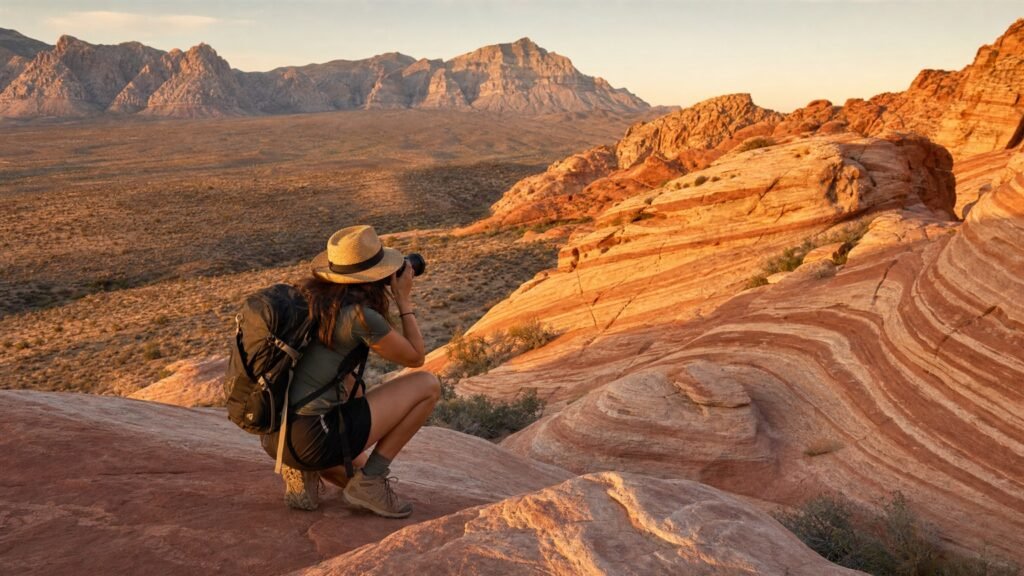
The Fire Wave Trail is the park’s showstopper. Less than 1.5 miles round trip, mostly flat, and the payoff is a sweeping expanse of banded sandstone that ripples like frozen waves across the desert floor. It looks like someone poured a giant latte across the landscape and it solidified in place.
At Atlatl Rock, you can climb a metal staircase bolted to the side of a boulder to get face-to-face with petroglyphs that are estimated to be over 3,000 years old. Standing inches from symbols carved by Ancestral Puebloan people, with nothing between you and the art but open air, is a full-body goosebumps experience.
The White Domes Loop Trail packs an absurd amount of scenery into just over a mile: narrow slot canyons, towering sandstone fins, and the crumbling remains of a 1960s movie set. It’s like hiking through three different planets in 45 minutes.
Important: Many trails close from May 15 through September 30 due to extreme heat, including Fire Wave, White Domes, and several others. If you’re visiting in summer, stick to the scenic drive and shorter walks near the visitor center, and bring significantly more water than you think you need.
For the less obvious experience, take the short walk to Mouse’s Tank, a natural water basin named after a Southern Paiute outlaw who used the canyon as a hideout in the 1890s. The trail is lined with petroglyphs on both sides, and the basin itself still collects rainwater, creating a tiny oasis among the red rock.
Book a guided Valley of Fire tour from Las Vegas →
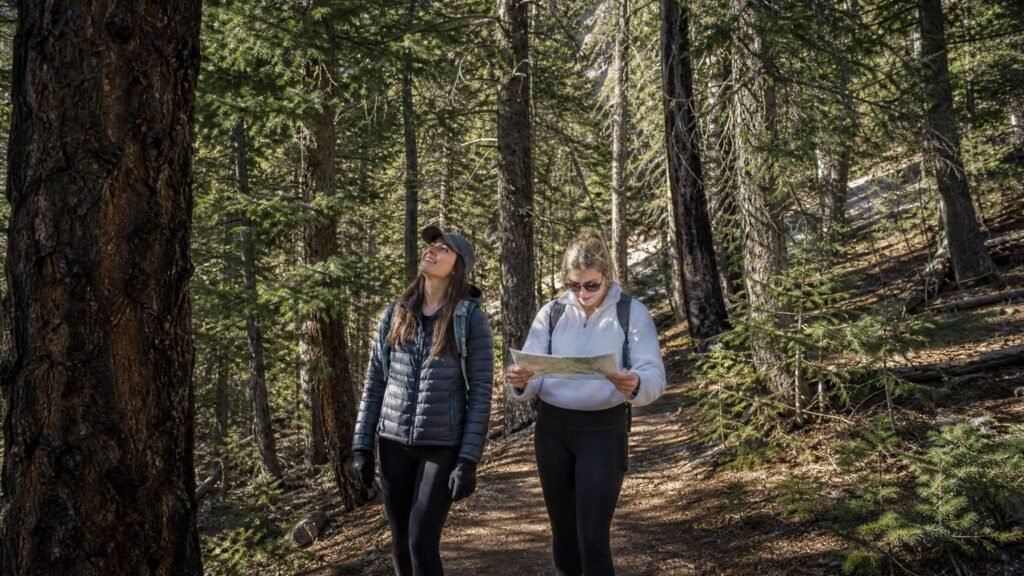
Mount Charleston: A Mountain Where You Can Escape the Heat (Seriously)
45 minutes from the Strip | Free entry (fees for some picnic areas) | Open year-round
Here’s a number that will change your entire trip planning calculus: the summit of Mount Charleston sits at 11,916 feet, and temperatures up here regularly run 30 to 40 degrees cooler than the Strip. When Las Vegas is pushing 110 in July, the mountain might be sitting at a gorgeous 75. With pine trees. And actual shade. And air that smells like a forest instead of recycled casino ventilation.
The Cathedral Rock Trail is the crowd favorite, and for good reason. At about 2.6 miles round trip, it’s manageable for most fitness levels and rewards you with sweeping views of Kyle Canyon and the surrounding peaks. The trail winds through ponderosa pine and white fir forest, and the payoff at the top is a panoramic vista that makes the 45-minute drive worth every second.
For a more relaxed afternoon, the Kyle Canyon Picnic Area sits nestled among towering pines and offers a shaded, cool refuge that feels impossible when you remember you were just on the Las Vegas Strip. Pack lunch, claim a table, and just breathe mountain air for a while.
The Spring Mountains are also home to ancient bristlecone pine trees, some of the oldest living organisms on Earth. These gnarled, wind-sculpted survivors have been growing up here for thousands of years, quietly outlasting empires, ice ages, and the entire history of Las Vegas. There’s something deeply humbling about standing next to a tree that was alive when the pyramids were being built.
In winter, Mount Charleston gets actual snow. The Lee Canyon ski area offers skiing and snowboarding , and snow tubing and snowshoeing for those who prefer their winter activities with less risk of a yard sale.
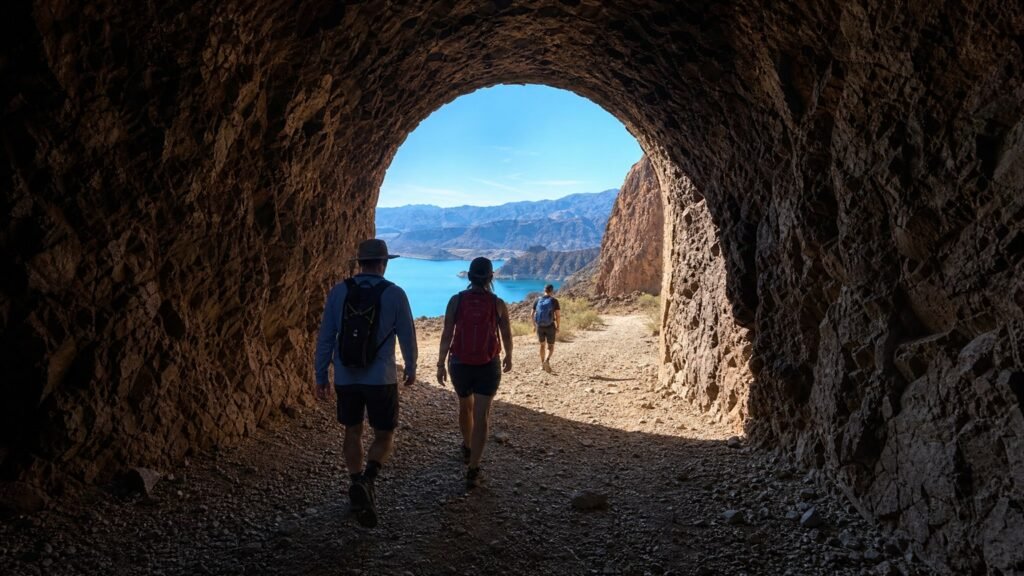
Lake Mead: America’s First National Recreation Area (And It’s Enormous)
30 minutes from the Strip | | Open year-round
Most people know Lake Mead exists. Far fewer realize just how massive and varied this place actually is. Lake Mead National Recreation Area sprawls across 1.5 million acres of desert mountains, deep canyons, and two enormous reservoirs straddling the Nevada-Arizona border. It’s the largest national recreation area in the country, and it starts less than half an hour from your hotel.
The absolute must-do here is the Historic Railroad Trail. This 3.7-mile one-way path follows the old railroad grade that workers used to haul materials during the construction of Hoover Dam in the 1930s. The route passes through five massive tunnels carved out of solid basalt, each about 25 feet wide and 300 feet long, and the views of Lake Mead framed through those dark tunnel openings are the kind of thing that stops you mid-step. The trail is flat, paved, and easy enough for just about anyone. And at the far end? Hoover Dam itself.
For something more rugged, Northshore Road is one of the most underrated scenic drives in the Southwest. The route winds along the northern shore of the lake past layers of red, orange, and white sedimentary rock that look like a geological layer cake sliced open. Pull off at the overlooks, and you’re staring down at bright blue water surrounded by raw desert cliffs that feel more like the Mediterranean coast than Nevada.
Pro Tip: Fill up your gas tank and grab supplies in Boulder City before you enter the park. Marina store prices inside the recreation area carry a serious markup, and there’s nothing worse than paying $7 for a bottle of water when you’re already sweating.
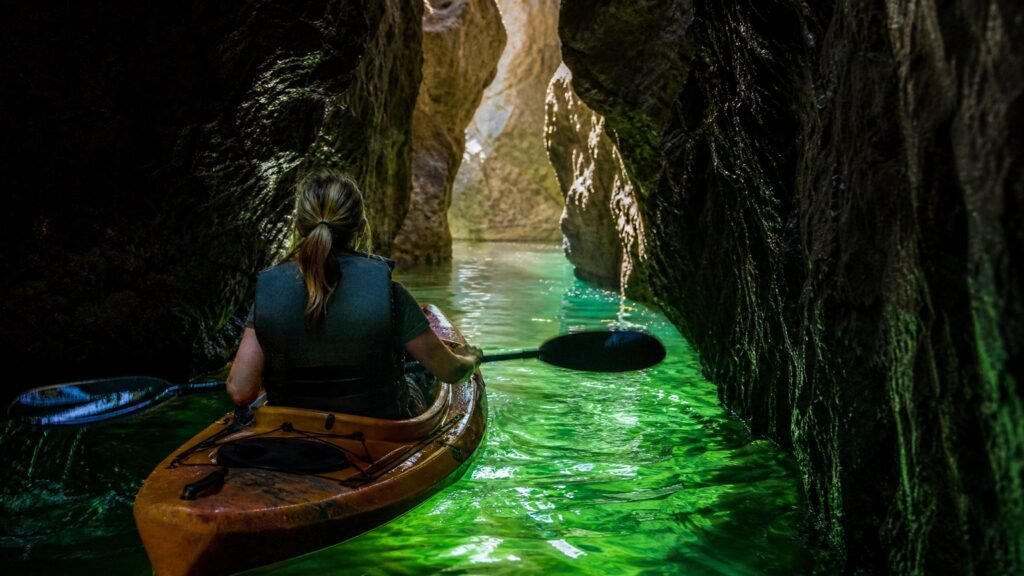
The Colorado River: Kayaking to Emerald Cave
45 minutes to Willow Beach launch | Guided tours | Best Oct-May
Here’s the moment that makes every single person on the kayak tour go quiet: you paddle around a bend in Black Canyon, slip into a narrow cave carved into the canyon wall, and the water beneath your kayak turns an impossible, glowing emerald green. Sunlight filters through the cave entrance and bounces off the shallow bottom, and suddenly you’re floating on what looks like liquid jade. It’s one of the most photographed natural wonders near Las Vegas, and no photo does it justice.
Emerald Cave sits along the Colorado River in Black Canyon, just below Hoover Dam. The only way to reach it is by water, and a guided kayak tour is the best way to experience it. Most tours launch from Willow Beach Marina in Arizona and cover about 5 miles round trip, paddling through a stunning river corridor with towering canyon walls, desert bighorn sheep on the cliffs above, and water so clear you can see the rocky bottom 20 feet down.
The paddle itself is mellow. The Colorado River in this section runs calm and flat, fed by cold water released from the bottom of Hoover Dam (expect water temps around 55 degrees year-round, which makes the swimming stops refreshingly shocking). No whitewater experience needed. If you can sit in a kayak and hold a paddle, you can do this trip.
Most guided tours run about 3.5 hours on the water and include snacks, a swimming stop, and all the gear. Several operators offer Las Vegas hotel pickup, which adds about 90 minutes each way but means you don’t need a rental car.
Pro Tip: Book a morning departure. The sunlight angles into Emerald Cave best in the late morning, creating that signature green glow. Afternoon trips still get inside the cave, but the color is less intense. And wear water shoes you don’t mind getting wet. Your feet will be in and out of the river all day.
Book an Emerald Cave kayak tour from Las Vegas →
The Secret Spots Most Visitors Never Find
Now we’re getting to the good stuff. These are the places your hotel concierge won’t mention, your tour operator doesn’t offer, and most Vegas travel blogs skip entirely. They’re spectacular, they’re accessible, and you’ll probably have them almost to yourself.
Sloan Canyon: 1,700 Ancient Petroglyphs That Almost Nobody Visits
25 minutes from the Strip | Free | Open sunrise to sunset
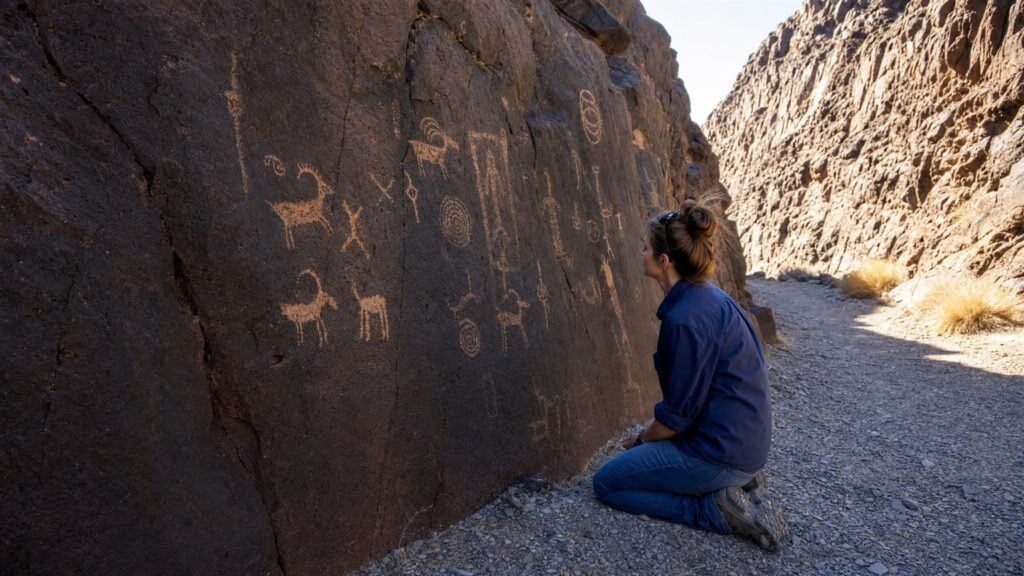
This one genuinely baffles me. There are over 1,700 individual petroglyphs across 300 rock art panels carved into the volcanic basalt walls of Sloan Canyon National Conservation Area, making it one of the most significant rock art sites in all of Southern Nevada. Some of these carvings date back thousands of years, created by Ancestral Puebloan, Patayan, and Southern Paiute people. Hunting scenes, ceremonial symbols, geometric designs, all of it etched into dark desert rock in a narrow canyon that feels untouched by time.
And almost nobody goes here.
The Petroglyph Canyon Trail is about 4 miles round trip with moderate elevation gain. The majority of the rock art is concentrated along a 500-foot stretch of the canyon, and when you round the corner and see panel after panel of ancient carvings covering both canyon walls, it genuinely stops you in your tracks. This isn’t behind glass. There’s no velvet rope. It’s just you and art that has survived in open air for millennia.
The trailhead is accessible from Henderson, just south of Las Vegas.
Pro Tip: Go in the morning when the sun hits the east-facing canyon walls and lights up the petroglyphs. Bring binoculars for the panels that sit higher on the walls. And please, never touch the rock art. The oils from your fingers can damage carvings that have survived thousands of years.
Clark County Wetlands Park: The “Wait, This Is Still Las Vegas?” Spot
15 minutes from the Strip | Free | Trails open dawn to dusk
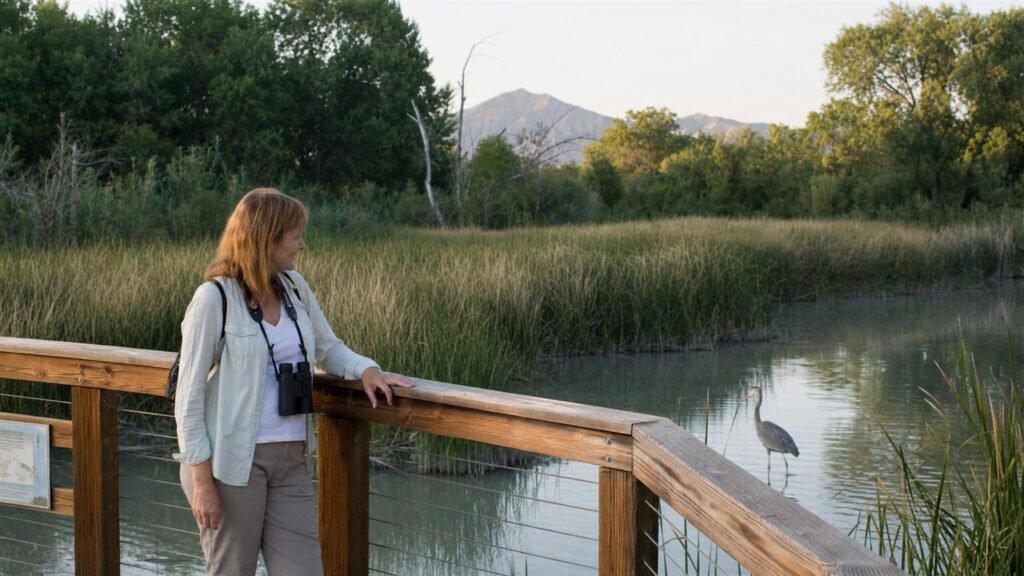
You will not believe this place exists until you’re standing in it. A 2,900-acre nature preserve with cottonwood groves, meandering streams, boardwalk trails through marshlands, and over 310 species of birds. In Las Vegas. Fifteen minutes from the casino floor.
The park sits along the Las Vegas Wash between the city and Henderson, and it’s this wonderfully bizarre pocket of lush, green, living wetland in the middle of one of the driest cities in America. The paved trail system covers about 12 miles total, and the shorter loops near the Nature Center are flat, shaded, and perfect for a morning walk when you need to clear your head after one too many late nights.
Birdwatchers absolutely lose their minds here. Great blue herons, red-tailed hawks, egrets, roadrunners, hummingbirds, the list goes on and on. The park is also home to beavers, coyotes, and desert cottontail rabbits, though the beavers are famously shy.
The Nature Center runs free guided walks, art programs, and kids’ activities (Tuesday through Sunday, 9 a.m. to 3 p.m.), making this a fantastic option for families or anyone who just needs a quiet, beautiful morning away from the sensory overload of the Strip.
Ash Meadows: A Desert Oasis That Feels Like Another Planet
90 minutes from the Strip | Free | Open sunrise to sunset
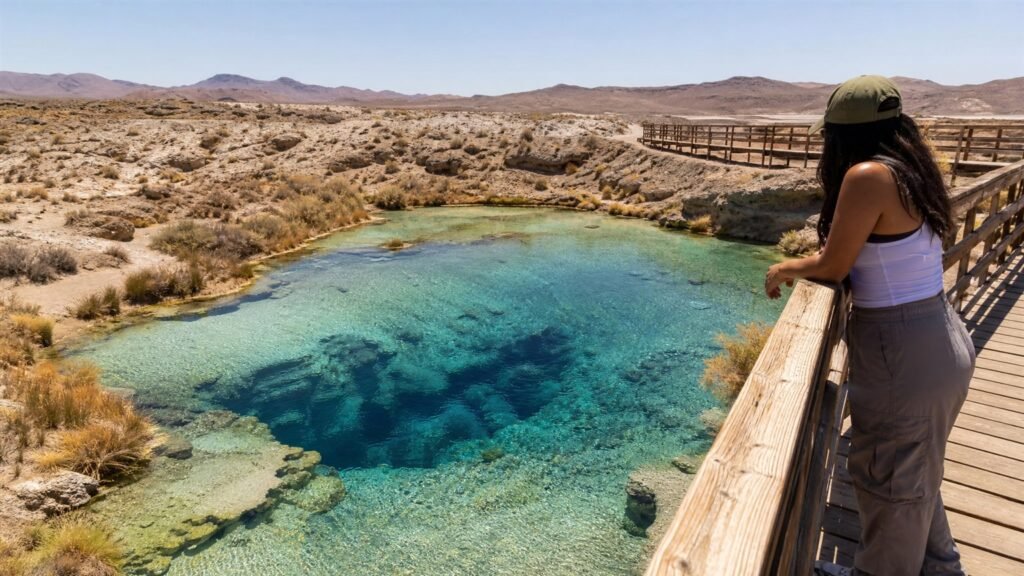
This is the farthest drive on the list, and also possibly the most surreal. Ash Meadows National Wildlife Refuge is a federally protected oasis in the Amargosa Valley where crystal-blue springs bubble up through the desert floor, feeding pools and marshlands that support species found nowhere else on the planet.
The star residents are the Devils Hole pupfish, a tiny, iridescent fish that lives in a single limestone cavern pool. They’ve been swimming in that exact spot for an estimated 10,000 to 20,000 years. The population fluctuates between just a few dozen and a few hundred individuals, making them one of the rarest fish on Earth. You can peer into the pool through a fenced overlook, and knowing that this entire species exists in one small hole in the desert is one of those facts that rewires your brain a little.
The Crystal Springs Boardwalk near the visitor center is an easy, flat loop of less than a mile that takes you past spring-fed pools of impossibly clear water, surrounded by desert vegetation and the constant soundtrack of birds. The contrast between the vivid blue water and the barren, brown landscape is striking.
Make sure you have a full tank of gas before you head out. The nearest gas station is about 25 miles from the refuge, and there are no services, no shade structures beyond the first rest area, and absolutely no cell service. In summer, this place is brutally hot. Spring and fall are ideal.
Pro Tip: Combine this with a stop at the Amargosa Opera House in Death Valley Junction, a charmingly eccentric desert landmark just a few miles farther down the road. It’s one of those only-in-Nevada detours that makes a great story.
Eldorado Canyon and Nelson Ghost Town: Wild West Meets Wild Canyon
45 minutes from the Strip | Free to explore Nelson |
The drive south from Boulder City to the tiny semi-ghost town of Nelson winds through some of the most dramatic canyon scenery near Las Vegas. Steep, mineral-streaked canyon walls plunge down toward the Colorado River, and the whole landscape has this raw, untamed energy that feels completely different from the polished desert parks up north.
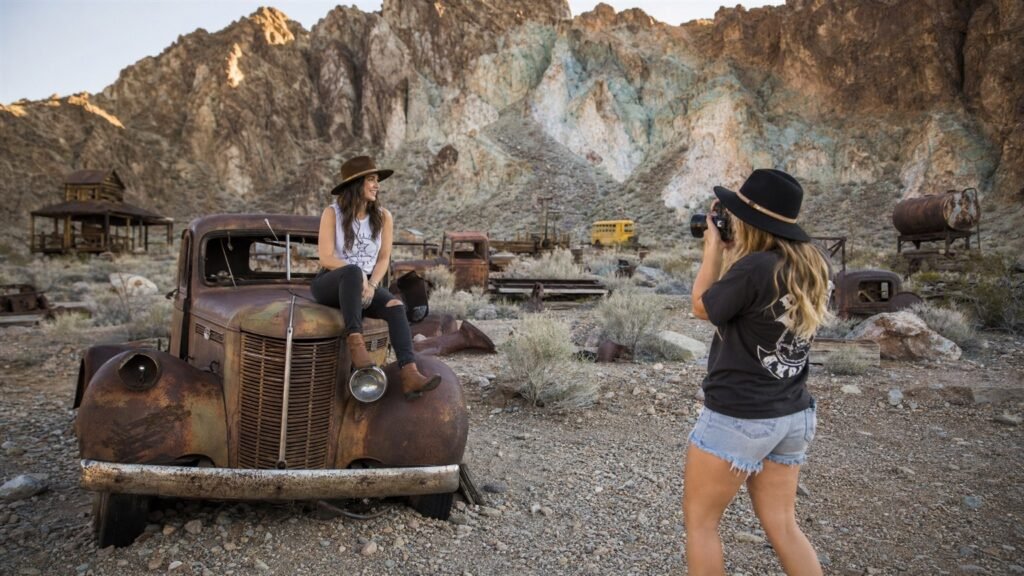
Nelson Ghost Town is a fascinating collection of vintage cars, old mining equipment, rusty Americana, and weathered buildings scattered across the desert. Photographers flock here for the combination of colorful junk art against dramatic desert backdrops, and it’s become one of the most popular portrait and wedding photo locations in the Vegas area. It’s free to wander around and shoot photos, though some areas are on private property, so respect the signs.
The real historical draw is the Techatticup Mine, the oldest and richest gold mine in southern Nevada. Operating from 1861 to 1942, it produced millions of dollars in gold, silver, copper, and lead, and the stories from its heyday involve Civil War deserters, claim-jumping murders, and illegal whiskey operations. Guided tours last about 80 minutes and take you into the actual mine tunnels to see the quartz veins where the gold ran.
For the adventurous: the road continues down to Lake Mojave at the bottom of the canyon, where brave souls cliff-jump into the deep water and kayakers explore the river corridor. The turquoise water against the dark canyon walls is striking.
Book an Eldorado Canyon and ghost town tour from Las Vegas →
When to Go and What to Bring
The Season-by-Season Breakdown
October through April is prime time. Temperatures are comfortable for hiking (50s to 80s), the light is gorgeous, and the desert wildflowers start popping in March and April. This is also when Red Rock Canyon requires timed entry reservations, so book ahead.
May through September is hot. Really hot. We’re talking 100 to 115 degrees on the valley floor. That doesn’t mean you can’t go outside, but it means you need to be strategic. Hit the trails before 8 a.m. or after 5 p.m., carry at least one liter of water per hour of hiking, and skip anything exposed and strenuous during midday. Mount Charleston is the obvious summer escape, with temps in the 70s and 80s when the city is melting.
Winter brings snow to Mount Charleston and cooler temperatures everywhere else. Valley of Fire and Red Rock are particularly beautiful on crisp winter mornings when the rocks seem to glow even brighter against clear blue skies.
What to Pack
No matter when you go, bring:
- More water than you think you need (seriously, double what you’d normally carry)
- Sunscreen and a hat, even on cloudy days
- Sturdy, closed-toe shoes with decent traction
- A light layer for the car (A/C to desert heat is a shock)
- Snacks, because there are no convenience stores in the middle of the desert
- A portable phone charger (using your camera drains the battery fast)
- Cash, for the few spots that charge parking or entry fees
Your Desert Adventure Starts Now
Look, I get it. You came to Vegas for the shows and the restaurants and the pool scene. And you should absolutely do all of those things. But if you leave Las Vegas without spending at least one morning in the desert, watching the sun paint ancient rock walls in colors that don’t exist anywhere else, you’re missing the real magic of this place.
Las Vegas wasn’t built in the middle of the desert by accident. It was built in the middle of one of the most extraordinary natural landscapes on the continent. The neon is incredible. But the sandstone was here first, and it’s not going anywhere.
So rent a car, set an alarm for sunrise, and go find a canyon that makes you forget your phone exists for a few hours. That’s the Vegas souvenir worth keeping.