Take the Kids to the Edge of the World: The Family Guide to Visiting the Grand Canyon from Las Vegas
One road trip. One natural wonder. A story your kids will tell for the rest of their lives.
It starts the way all great family adventures do: someone has already asked “are we there yet?” before you’ve cleared the Strip. The hotel breakfast buffet has been raided. A juice box has been spilled. And you, armed with a full tank of gas and a plan, are about to do something that will make every other family vacation feel slightly less impressive.
You’re driving to the Grand Canyon.
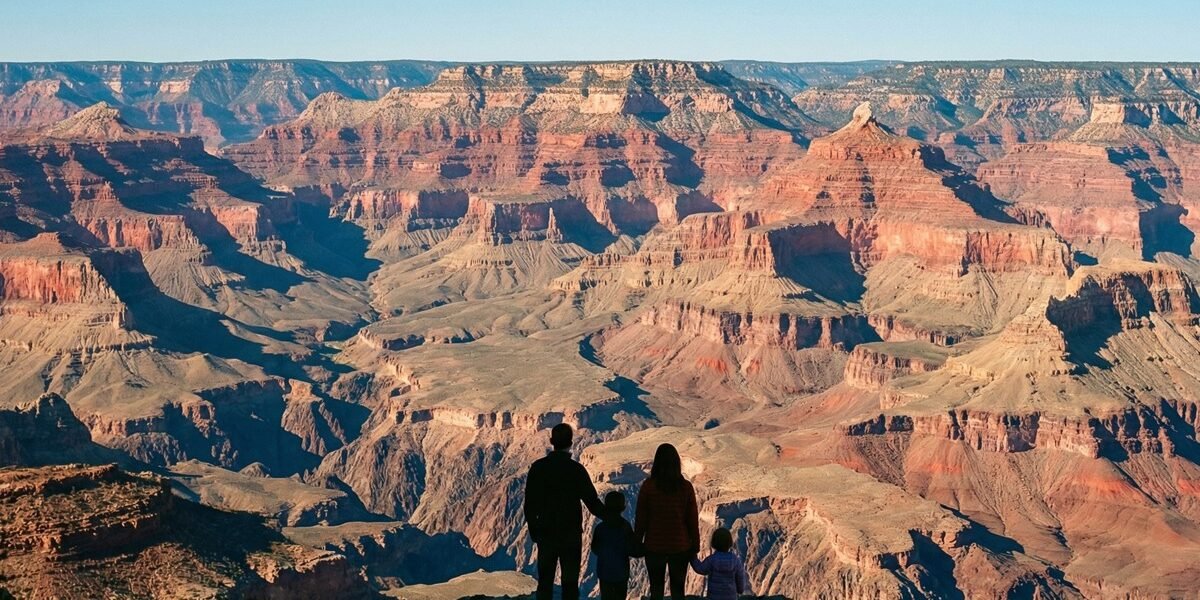
Not a picture of it. Not a documentary about it. The actual thing. A mile deep, up to 18 miles wide, and 277 river miles of geological astonishment carved over five million years by the Colorado River. The Grand Canyon is one of those rare places that stops even the most easily distracted ten-year-old cold.
No screen, no theme park ride, no Vegas spectacle compares. The moment the canyon rim appears and the earth just drops away in front of you, something shifts. Kids go quiet. Adults forget to take photos. Everyone just stands there, blinking, recalibrating their understanding of how big the world actually is.
The best part? From Las Vegas, it’s entirely doable. Whether you have a single action-packed day or a leisurely two-night adventure, this guide covers everything your family needs: where to stop along the way, which Grand Canyon to visit (yes, there’s more than one option), what to do when you get there, how to keep kids genuinely engaged, and how to pull it all off without spending a fortune.
Load up the car. This is the trip within the trip.
First Things First: Which Grand Canyon Are You Going To?
Here’s something most first-timers don’t realize until they start googling: there are two distinct Grand Canyon destinations you can reach from Las Vegas, and they deliver very different experiences. Choosing the right one for your family makes all the difference.
The South Rim: Grand Canyon National Park
This is the Grand Canyon you’ve seen in every magazine, every nature documentary, every jaw-dropping desktop wallpaper. The South Rim is part of Grand Canyon National Park, managed by the National Park Service, and it’s approximately 280 miles and 4.5 to 5 hours from Las Vegas.
The views are iconic, the infrastructure is excellent, and there’s genuinely so much to do that families with kids of any age can fill an entire day (or two) without running out of things to discover. Ranger programs, free shuttle buses, kid-friendly trails, the legendary Junior Ranger badge program, multiple viewpoints stretching for miles, and enough historic lodges and visitor centers to keep everyone oriented and happy.
For first-time visitors and families who want the real, full-scale Grand Canyon experience, the South Rim wins every time. It’s a longer drive, but the payoff is extraordinary.
The West Rim: Grand Canyon West
The West Rim is approximately 130 miles from Las Vegas, about 2.5 hours away, and it’s operated by the Hualapai Tribe on tribal land. It’s not part of Grand Canyon National Park. Its biggest draw is the Skywalk, a glass-bottom horseshoe walkway that juts out over the canyon 4,000 feet above the floor below.
Thrilling for older kids and brave adults. The West Rim also features Eagle Point and Guano Point, both genuinely spectacular viewpoints.
The trade-offs are real, though. The All-Access Pass runs $99 per person (roughly $113 with taxes and fees), and that adds up fast for a family. Personal cameras aren’t allowed on the Skywalk (they sell you photos inside), and the last stretch of road is unpaved if you drive yourself. It feels more like a ticketed attraction than a national park.
One genuinely great family perk: when you buy one adult All-Access Pass, up to two kids ages 5 to 12 get in free. Children under 5 are always free. That softens the sticker shock considerably.
It’s a solid choice for families pressed for time who want a taste of the canyon without a full-day commitment. But for most families making this trip from Vegas, especially first-timers, the South Rim is the destination worth planning around.
Road Trip Mode: The Drive to the South Rim
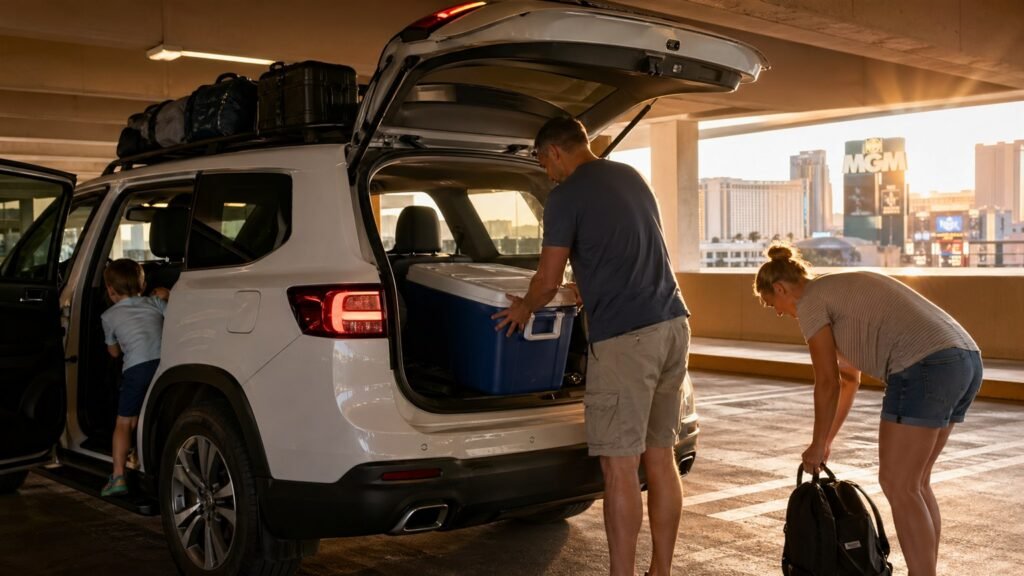
The drive from Las Vegas to the South Rim is about 4.5 to 5 hours without stops. With the right stops, it becomes part of the adventure. Leave by 6:30 or 7:00 in the morning. Pack a cooler with snacks, drinks, and sandwiches (food inside the park is available but pricey, and a packed lunch eaten at the rim is an experience in itself).
Download a playlist, load up an audiobook, and tell the kids that what they’re about to see will be worth every single mile.
The route takes you south on US-93, east on I-40, then north on AZ-64 through Williams to the South Rim. It’s straightforward, well-signed, and the desert scenery rolling by the windows is its own kind of spectacular.
Stop One: Hoover Dam
About 30 miles and 30 minutes outside of Las Vegas, you pass right by one of the most impressive feats of human engineering on the planet. Hoover Dam is a genuinely worthwhile stop for families, and you have options for how long to linger.
For a quick stretch-and-snap, pull over and walk across the Mike O’Callaghan-Pat Tillman Memorial Bridge. It’s free, it offers sweeping views of the dam and Lake Mead, and it gives everyone a chance to shake out the car legs before hitting the highway again.
For families who want to go deeper, the Visitor Center costs $15 per person (free for kids 3 and under), with parking at $10 per vehicle. Guided dam tours run $25 to $40 per person and include access to the power plant interior. Wait times can run long during peak season, so factor that into your timing if you go the tour route.
Practical Tip: Hoover Dam Logistics
Arrive early in the morning before the heat and crowds build. Pack sunscreen and hats because it gets genuinely hot here with no shade. Strollers work fine on the bridge. The dam interior tour involves stairs. Skip the tour if you’re on a tight timeline. The bridge view alone is worth the stop.
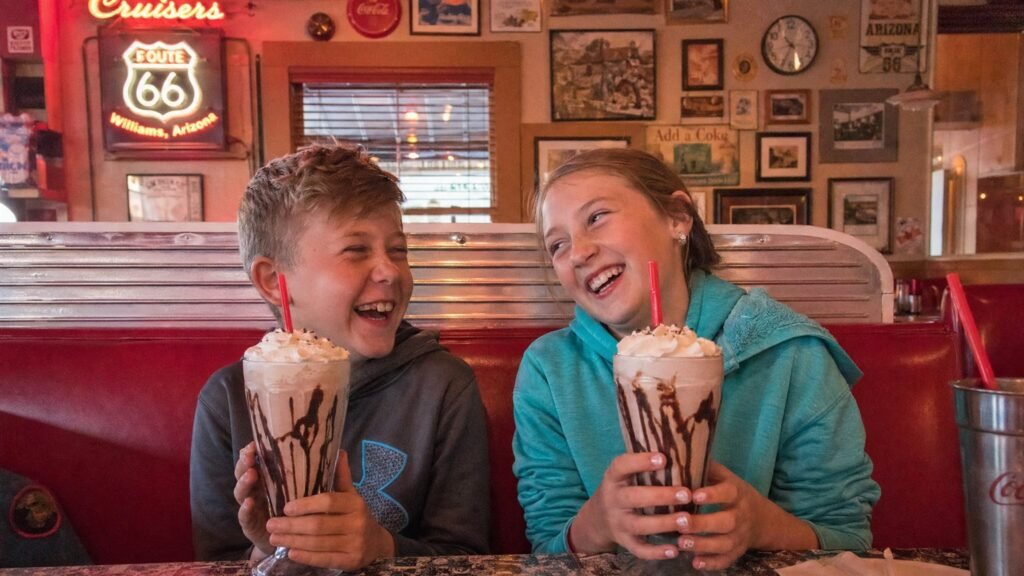
Williams, Arizona: The Pit Stop You Didn’t Know You Needed
About an hour south of the Grand Canyon’s South Rim, tucked along Historic Route 66, sits Williams, Arizona. It has one main street lined with diners, souvenir shops, and vintage signs.
Williams is charming in the way that small American towns with a real identity are always charming. It feels unhurried. It feels like a different era. For families doing a two-day version of this trip, it’s the perfect base camp, and for everyone else, it’s a perfect reason to stretch your legs and eat something that isn’t gas station trail mix.
Bearizona Wildlife Park: A Bonus Adventure
If you’re spending a night in Williams or arriving with energy to spare, Bearizona is a drive-through wildlife park just outside of town that families consistently love. You motor slowly through three miles of ponderosa pine forest where black bears, wolves, bison, bighorn sheep, and other North American animals roam freely around your car.
Then you park and walk through Fort Bearizona, a 20-acre walk-through area to see smaller animals up close. The park is open daily from 8 AM to 6 PM, and admission runs approximately $30 for adults, $15 for kids.
Canyon Coaster Adventure Park: For the Energy That Never Ends
If your kids have somehow retained energy after the drive or a day at the canyon, Canyon Coaster Adventure Park on Route 66 in Williams has Arizona’s first mountain coaster, a ride built directly into the mountainside that sends riders careening down the slope in their own individual cars.
It’s the kind of activity that produces screaming, then laughing, then immediate demands for another run. A single ride costs approximately $20 per person, and the park also offers tubing (snow tubing in winter, summer tubing in warmer months). A solid evening activity if you’re based in Williams overnight.
The Grand Canyon Railway: The Most Fun Way to Arrive
If you want to do something genuinely unforgettable, skip the car for the last leg of the journey and take the train. The Grand Canyon Railway departs Williams every morning and arrives at the South Rim about two and a quarter hours later on a historic locomotive.
But here’s what makes it magical for families: somewhere along the route, a gang of actors in cowboy gear stages a theatrical train robbery. The “outlaws” board the train, make their demands, and the whole thing plays out like a Wild West show on wheels.
Kids lose their minds for it. Even the ones who are too cool to admit they’re entertained can’t help grinning. Book this well in advance, particularly for summer travel. It sells out.
Coach Class tickets start at $89.98 for adults and $57.98 for kids ages 2 to 15. Children under 2 ride free. In 2026, there’s a Route 66 centennial promo: use code ROUTE66 for $66 Coach Class tickets. There’s also a “Kids Ride Free” deal for Pullman Class on select dates through September 2026, with adults getting 25% off. Check the railway’s offers page for the latest deals.
Cruiser’s Cafe 66: Lunch Worth Stopping For
Right on the main strip in Williams, Cruiser’s Cafe 66 is a classic American diner done right. Burgers, milkshakes, vintage cars parked out front, neon signs inside. It’s exactly the kind of place that makes a road trip feel like a road trip.
Pull in for lunch on your way to or from the canyon and let the kids order something ridiculous off the milkshake menu. No regrets.
The Ideal 2-Night Family Itinerary
Night 1: Drive from Las Vegas, stop at Hoover Dam, arrive in Williams and check in.
Day 2: Board the Grand Canyon Railway in the morning, spend the full day at the South Rim, earn Junior Ranger badges, take the train back to Williams in the evening.
Day 3: Optional Bearizona visit in the morning, then drive back to Las Vegas.
Williams hotels and motels are significantly cheaper than lodging inside the park. The Grand Canyon Railway Hotel sits right at the train station and is built for families doing exactly this trip.
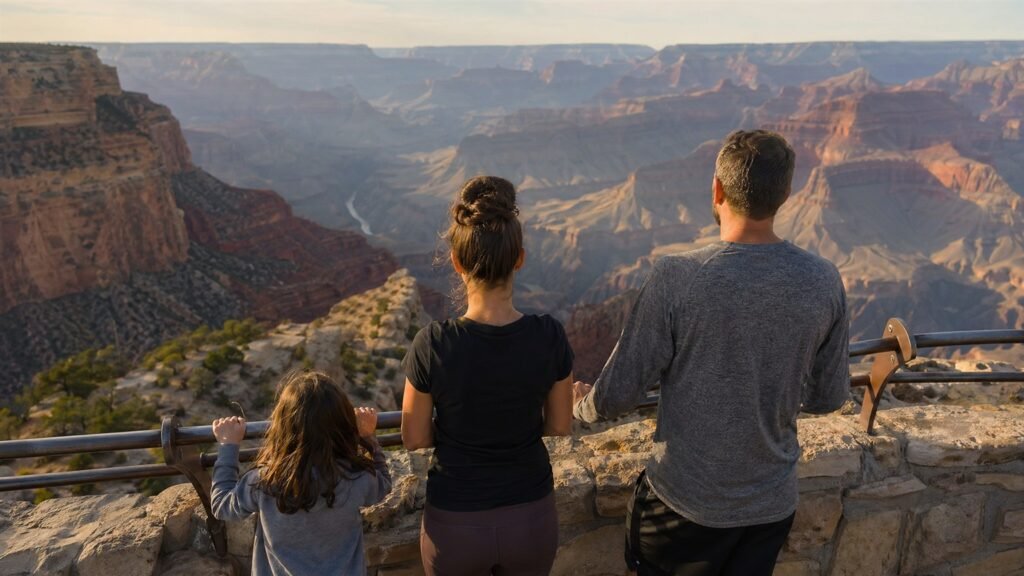
At the South Rim: What Families Actually Do There
You’ve arrived. Step out of the car, walk toward the rim, and let it happen. The first time you see it, and we mean the very first moment the canyon opens up in front of you, it’s like nothing you’ve anticipated. You can look at a thousand photographs and still not be ready for the actual scale of the thing. That initial silence from the kids is worth every mile of the drive.
Here’s how to make the most of your time at the South Rim with family in tow.
Grand Canyon Visitor Center and Mather Point
Start here, always. The Grand Canyon Visitor Center near Mather Point is your orientation hub. Pick up free maps, talk to rangers, check the schedule for ranger-led programs, and grab the Junior Ranger booklets (more on those shortly).
Then walk the short path to Mather Point, which delivers the iconic sweeping panorama that confirms you have, in fact, arrived at one of the great natural wonders of the world. For most kids, this is the moment. Take your time here.
Important for 2026: Cash is no longer accepted at South Rim entrance stations. Have a credit or debit card ready, or purchase your entry pass online before you arrive.
The Rim Trail
The Rim Trail runs along the canyon’s edge for 13 miles and connects multiple viewpoints. Much of it is paved or packed gravel, making it accessible for strollers in many sections, and you can walk as little or as much as your family’s energy allows.
The 1.2-mile stretch between Mather Point and Yavapai Point is the sweet spot for families: stunning overlooks every few hundred feet, mostly flat, and if anyone runs out of steam, you can hop on the free shuttle bus at the next stop.
Each viewpoint along the trail offers a slightly different perspective on the canyon, and every single one of them is worth stopping for. Let the kids set the pace and don’t feel obligated to power-hike the whole thing.
The Trail of Time: Science Class, but Actually Fun
Between Yavapai Point and the Verkamp’s Visitor Center, the Trail of Time turns a casual rim walk into an interactive earth science experience. Bronze medallions embedded in the trail count down geological time, interpretive signs explain rock layers in kid-friendly language, and touchable rock samples along the way encourage hands-on exploration.
For kids who want to understand what they’re looking at (and for the parents who don’t want to keep saying “it’s just really, really old”), the Trail of Time makes the canyon’s 1.8-billion-year story feel tangible and fascinating.
The Free Shuttle Buses
Once you’re inside the park, there’s no need to move the car. The South Rim has an excellent network of free shuttle buses that run along the rim and connect to major viewpoints, trailheads, and facilities.
The buses are easy to use, well-marked, and kid-friendly. Hop on, ride a few stops, hop off and explore, hop back on. It’s genuinely one of the most family-friendly public transit systems in any national park.
Yavapai Geology Museum
Free, informative, and genuinely interesting for older kids who want to understand what they’re looking at. The Yavapai Geology Museum features interactive displays about how the canyon formed, what the rock layers represent, and how long all of this has been here.
The building also has large windows framing one of the best views on the rim. Worth a stop even if the kids breeze through in fifteen minutes.
Bright Angel Trail: A Taste of the Inside
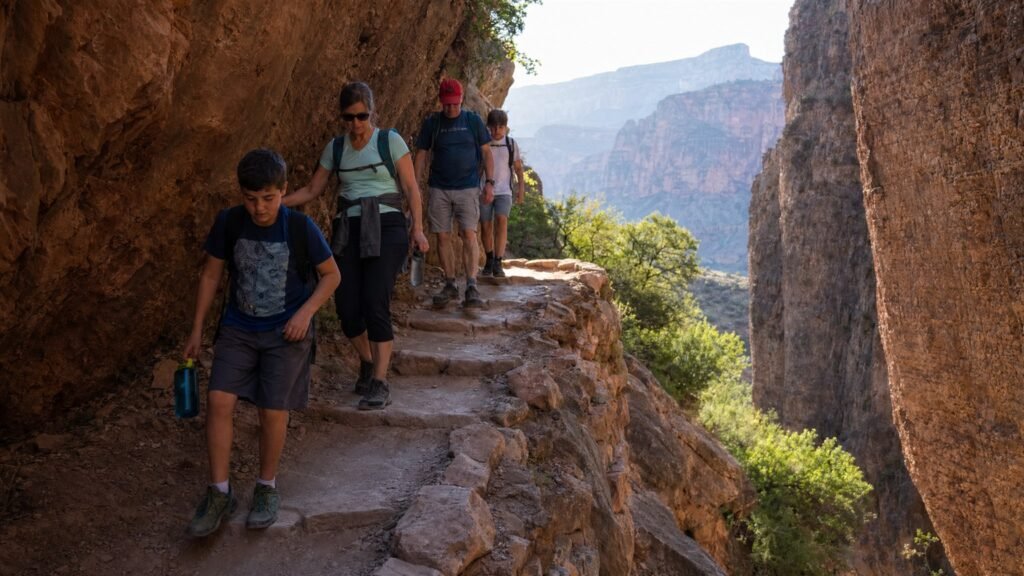
For families who want to actually step down into the canyon rather than just look at it from the top, Bright Angel Trail is the classic choice. You don’t need to hike far. Walking just the first half mile to a mile down the trail gives you the extraordinary experience of being inside the canyon walls, surrounded by layered rock that has been here since before humans existed on this planet.
The first 0.5 miles descends about 200 feet with wide, manageable switchbacks. It’s enough to feel the shift from spectator to explorer without overextending anyone.
Important family note that rangers repeat constantly and for very good reason: going down is easy. Coming back up is significantly harder, especially in the heat. Turn around well before anyone feels tired. Bring more water than you think you need. Children tend to dramatically underestimate how challenging the return climb feels. And never, ever hike below the rim in the middle of a summer day. Morning is the time.
South Kaibab Trail to Ooh Aah Point: The View That Earns Its Name
For families with older kids (roughly 8 and up) looking for a short but memorable below-the-rim experience, the South Kaibab Trail to Ooh Aah Point delivers. It’s a 1.8-mile round trip with about 760 feet of elevation change. Steeper than Bright Angel, but the reward is an exposed, 360-degree panorama that genuinely makes people say “ooh” and “aah” out loud. Hence the name.
The South Kaibab Trailhead is accessible only by shuttle bus (no private vehicles), which actually makes logistics simpler. Just know: there’s no water on this trail, so bring plenty.
Trail Cheat Sheet for Families
Rim Trail (Mather to Yavapai): 1.2 miles, flat, paved, stroller-friendly. Perfect for all ages.
Trail of Time: 1.3 miles, flat, interactive geology walk. Great for curious kids.
Bright Angel Trail (first section): 1 mile round trip, moderate descent. Good for ages 5+.
South Kaibab to Ooh Aah Point: 1.8 miles round trip, steeper. Best for ages 8+.
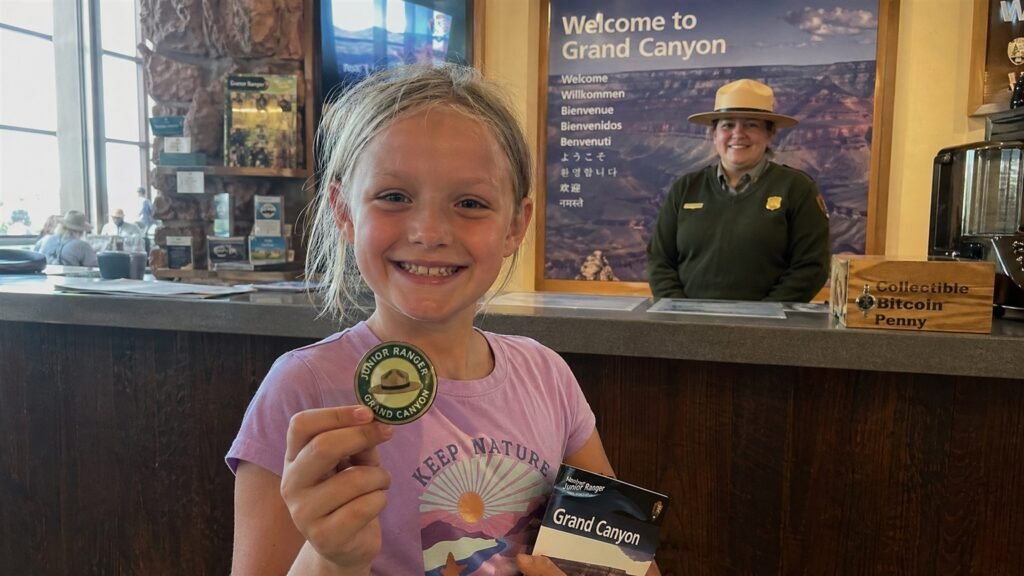
The Junior Ranger Program: Every Kid’s Favorite Souvenir
If you take one piece of advice from this entire article, let it be this: do the Junior Ranger program. It will transform your family’s visit from a sightseeing stop into a genuine adventure with stakes, purpose, and a deeply satisfying payoff at the end.
Here’s how it works. Pick up the free Junior Ranger Activity Booklet at the Grand Canyon Visitor Center, Yavapai Geology Museum, Kolb Studio, or Tusayan Museum. The booklet contains age-appropriate activities: drawing canyon formations, recording nature observations, writing responses to what they discover, and attending at least one ranger-led program.
When the booklet is complete, the child brings it back to the visitor center, where an actual park ranger reviews it, swears them in with an official pledge, and presents them with an official Grand Canyon Junior Ranger badge.
The badge is not a trinket. It’s earned. Kids know the difference, and they wear it accordingly. Age levels are available for ages 4 to 7, 8 to 10, and 11 and up, so every age group has appropriately challenging activities.
The whole program is completely free. And unlike the stuffed animal from the gift shop that will be forgotten in a hotel room, the Junior Ranger badge tends to go home on the kid’s shirt and stay there for the rest of the trip.
Pro Parent Move
Pick up the booklet the moment you arrive and let the kids start working on it right away. The activities naturally guide them to pay attention to what they’re seeing, ask questions, and engage more deeply with the canyon. It essentially gamifies the whole visit in the best possible way.
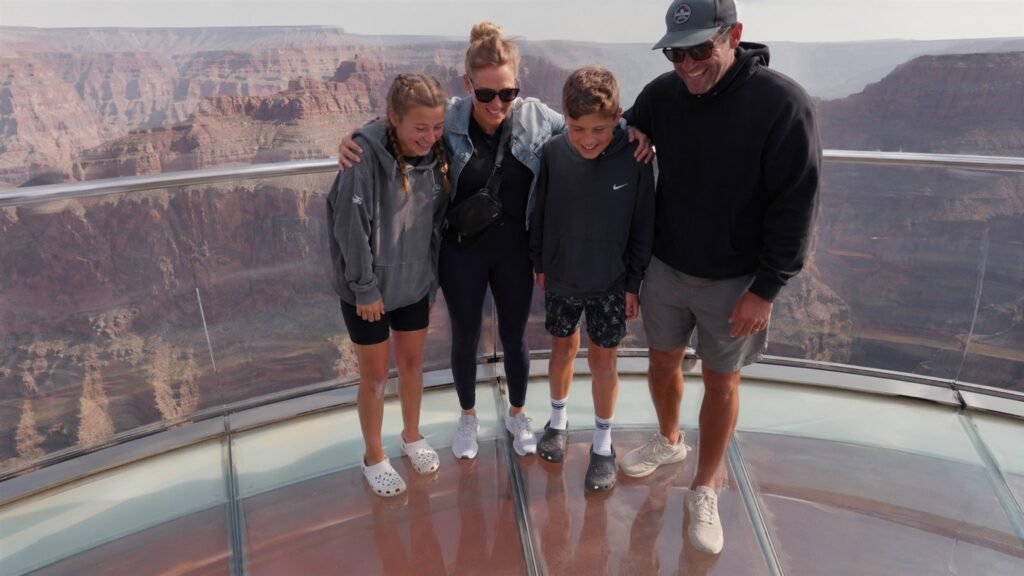
The West Rim Option: The Skywalk and What to Know
If the South Rim’s drive feels like too much for your timeline, the West Rim is worth an honest look. At about 130 miles from Las Vegas and a 2.5-hour drive, it’s considerably more accessible for a day trip. Just know what you’re getting into before you go.
Grand Canyon West is operated by the Hualapai Tribe on tribal land and is a separate, privately run attraction, not a national park. Its signature experience is the Skywalk: a horseshoe-shaped glass-bottom walkway that extends out over the canyon approximately 70 feet, with nothing but 4,000 feet of air between you and the canyon floor.
For older kids and thrill-seeking adults, it’s a genuinely vertiginous and memorable experience.
A few things families should understand before booking. Personal cameras aren’t permitted on the Skywalk (the park sells you photos inside). The All-Access Pass costs $99 per person (approximately $113 with taxes and fees), which covers the Skywalk, zipline, shuttle between viewpoints, and cultural experiences. The family-friendly pricing helps: buy one adult pass and up to two kids ages 5 to 12 get in free. Kids under 5 are always free.
Other packages start at $68 for general admission without the Skywalk. If you drive yourself, be aware that the last stretch of the access road is unpaved, and some rental car policies consider this a liability issue. For families, a guided tour from Las Vegas is generally the easier option.
Eagle Point and Guano Point, the two main viewpoints at Grand Canyon West, are genuinely stunning even without the Skywalk. The canyon views here are real and spectacular.
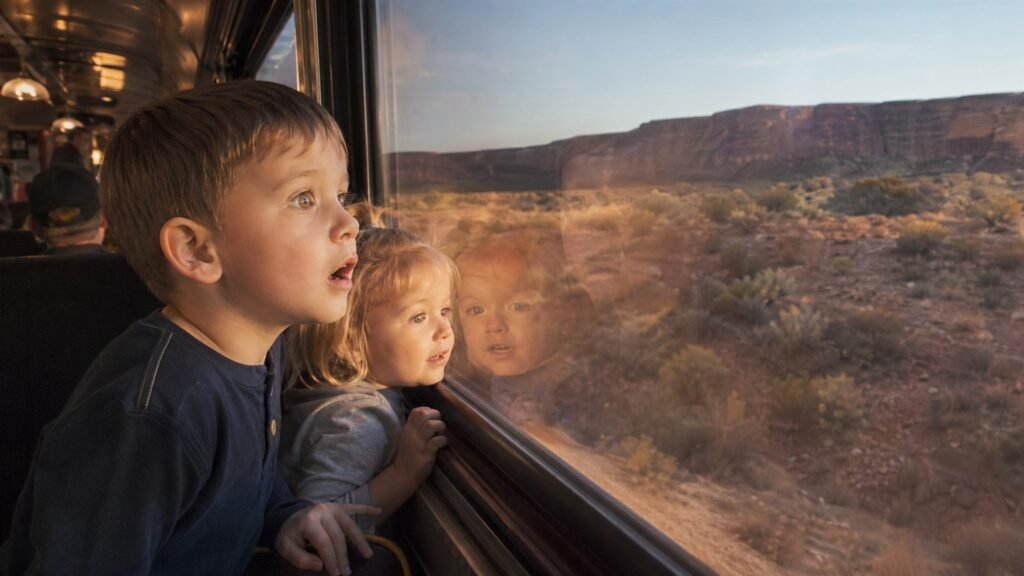
Tour vs. Self-Drive: The Honest Family Breakdown
How you get there matters almost as much as where you’re going, especially with kids in tow. Here’s a clear-eyed look at the options.
Self-Drive (Rent a Car)
Maximum flexibility, maximum control, and genuinely the best option for most families. You stop when you want (Hoover Dam, Williams, a random roadside view that catches your eye), you go at your own pace at the canyon, you can bring a fully stocked cooler, and the $35 vehicle entrance fee at the South Rim covers every person in the car for seven days.
If you have a rental car already or drove to Las Vegas, this is almost certainly the way to go. Gas, snacks, and the entry fee can put a family of four at the South Rim for well under $150 total.
Guided Bus Tours
If you don’t have a car or don’t want to navigate the drive, guided tours depart from Las Vegas hotels daily for both the West Rim and South Rim. West Rim bus tours run from about $80 to $100 per person and are a manageable day.
South Rim bus tours are a serious commitment: expect roughly 15 to 18 hours door to door, with a few hours actually at the canyon. Not impossible, but not ideal for families who need early bedtimes or whose patience has a mileage limit. Viator and GetYourGuide both list multiple options with reviews from other families.
Small Group and Van Tours
The sweet spot for families who want guided convenience without the big-bus experience. Small group tours cap at around 8 to 14 passengers, offer hotel pickup, and provide a more flexible, intimate experience.
They cost more than bus tours but significantly less than helicopter options. Worth the premium for families, particularly for the West Rim.
The Grand Canyon Railway
Covered in the Williams section above, but worth repeating: for the South Rim, the Grand Canyon Railway is a legitimately magical way to arrive. The train robbery performance alone earns its place in family trip lore.
If budget allows and you’re staying overnight in Williams, strongly consider this option for the canyon leg of your trip.
Helicopter Tours
Yes, you can fly to the Grand Canyon. Several operators, including Maverick Helicopters, offer helicopter tours from Las Vegas over Hoover Dam and Lake Mead, with some packages including a landing on the canyon floor.
It’s spectacular, and it’s expensive: generally $269 to $739 per person depending on the route, duration, and whether you land in the canyon. Additional costs include fuel surcharges ($15 to $35) and optional front-seat upgrades ($50 to $60).
Good news for families: children of all ages are welcome. Kids over 2 need their own seat. Children under 2 can sit on a parent’s lap (bring a birth certificate or passport as proof of age per FAA regulations). Kids 16 and under need an accompanying adult.
If your family has the budget and older kids who would fully appreciate it, a helicopter tour is a bucket-list experience unlike anything else. Book far in advance.
Booking Tip
Whatever option you choose, book earlier than you think you need to. The Grand Canyon Railway sells out weeks ahead in summer. Good hotel rooms in Williams go fast on holiday weekends. Helicopter tours book up quickly year-round. Procrastination is expensive here.
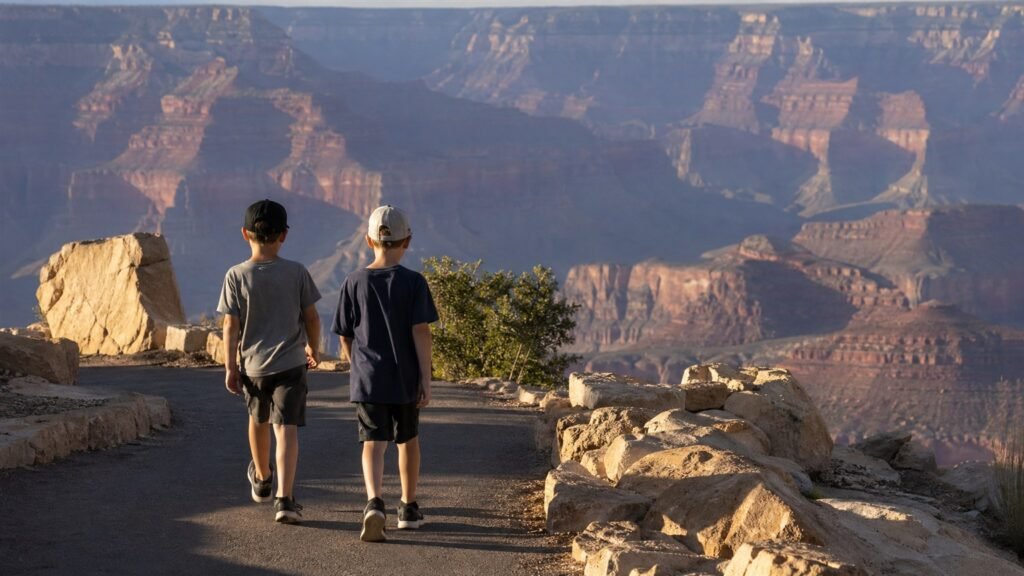
Costs and Budget Tips: Making It Work for Any Family
Here’s the genuinely wonderful news about the South Rim: it’s one of the best deals in American family travel once you get past the drive. The entrance fee is $35 per vehicle, covering every person in the car, valid for seven consecutive days.
The shuttle buses inside the park are free. Ranger programs are free. The Junior Ranger program is free. A family of four can have a legitimately extraordinary day at one of the seven natural wonders of the world for a fraction of what a theme park day would cost.
Complete Cost Breakdown
| Item | Cost |
|---|---|
| South Rim park entrance | $35 per vehicle (all passengers, valid 7 days) |
| America the Beautiful Annual Pass | $80, covers 2,000+ federal sites for 12 months |
| Junior Ranger program | Free |
| Shuttle buses inside the park | Free |
| Ranger programs | Free |
| Grand Canyon Railway (Coach) | From $89.98/adult, $57.98/child |
| Bearizona Wildlife Park | Approximately $30/adult, $15/child |
| Hoover Dam Visitor Center | $15/person, parking $10 |
| West Rim All-Access Pass | ~$99/person (~$113 with taxes) |
| Helicopter tours | $269 to $739/person |
Note for international visitors: As of January 2026, non-U.S. residents aged 16 and older must pay an additional $100 per person surcharge at Grand Canyon National Park, on top of the standard entrance fee. An America the Beautiful Non-Resident Annual Pass ($250) waives this surcharge.
Best Budget Approach for a Family of Four
Self-drive to the South Rim: $35 total (vehicle entry). Pack lunch and snacks in a cooler: saves $40 to $60 vs. buying food at the park. Free shuttle buses, free ranger programs, free Junior Ranger badges. Walk part of the Rim Trail and the first mile of Bright Angel Trail. Total cost for the canyon itself: well under $100 for four people. That’s a once-in-a-lifetime experience for less than a Vegas brunch.
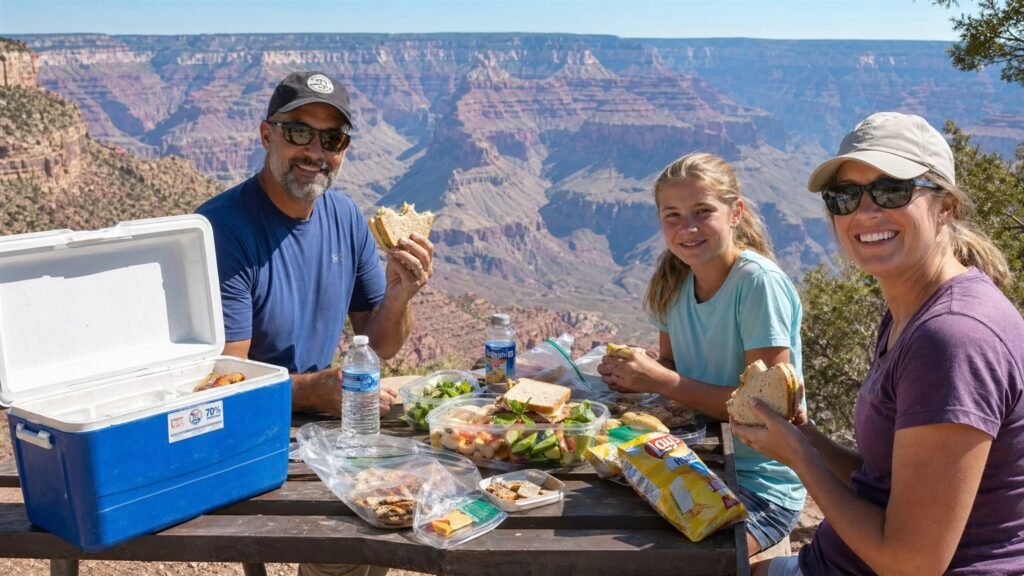
Practical Logistics: The Stuff That Makes or Breaks the Day
When to Go
Spring (March through May) and fall (September through November) are the ideal windows for a family Grand Canyon trip. Temperatures are comfortable, the crowds are manageable, and the light on the canyon walls at those times of year is genuinely something special.
Summer is absolutely doable but comes with caveats: it’s the busiest season, parking fills early, and the heat requires discipline. Start your hike by 8:00 in the morning, carry more water than you think you could possibly need, and get off exposed trails before the midday heat peaks.
Winter visits offer a dramatically less crowded canyon, often with snow dusting the rim and a certain hushed quality to the whole experience. Just pack real layers and check road conditions before driving in.
What to Pack
Water: One liter per person per hour of hiking is the ranger recommendation. Bring more than that. The canyon air is dry and the elevation (7,000 feet at the rim) dehydrates you faster than you’d expect.
Sun protection: Sunscreen, wide-brimmed hats, and sunglasses for everyone. The canyon offers minimal shade on the rim.
Footwear: Comfortable closed-toe shoes. Sandals are fine on the paved Rim Trail, but not for any canyon trails.
Layers: Even in summer, the elevation means cooler mornings and evenings. A light jacket for everyone.
Food: Snacks and a packed lunch. Food inside the park is available but pricey, and eating at the rim is an experience you can’t buy at the El Tovar dining room anyway (okay, you can there, but the cooler lunch is better for the budget).
Power: A fully charged phone and a portable battery pack. You will take many, many photos.
Stroller and Accessibility Notes
The Rim Trail is partially paved and navigable with strollers in many sections, particularly near the visitor center and main viewpoints. Canyon trails, including Bright Angel Trail and South Kaibab Trail, are not stroller-accessible.
Families with babies and toddlers do well here. A front carrier or structured baby carrier works beautifully for the rim walk and lets little ones experience the canyon up close without any safety concerns at the edge.
Entry and Parking
No timed entry reservation is required to enter Grand Canyon National Park at the South Rim. You pay your entry fee at the gate (or show your America the Beautiful Pass) and in you go. Cash is no longer accepted at entrance stations, so have a credit or debit card ready.
That said, summer weekends fill the parking lots early, so arriving before 9:00 in the morning is strongly advised. If the main lots are full, the shuttle from the gateway town of Tusayan (just outside the South Entrance) is also an option.
Overnight Strategy
If your family can swing two days, do it. Staying overnight opens up the single most spectacular free experience the Grand Canyon offers: sunrise over the rim. If you’ve never watched a canyon materialize out of darkness as the light slowly builds, bleeding through purples and blues and then burning into golds and reds as the sun clears the horizon, you haven’t quite understood what the phrase “life-changing view” actually means.
Williams is your best bet for affordable, charming accommodations. It’s about an hour from the South Rim with plenty of family-friendly motels and the Grand Canyon Railway Hotel right at the train station.
Tusayan, the small town just outside the South Entrance, is a convenient middle ground: close to the park, with several chain hotels and restaurants.
Inside the park, Bright Angel Lodge and Yavapai Lodge are magical but must be booked months in advance through Grand Canyon Lodges.
Go. Seriously. Go.
Las Vegas will be there when you get back. The blackjack tables, the buffets, the light shows, the pools, all of it exactly as you left it. But the Grand Canyon is a different category of experience entirely, and the families who make the drive always say the same thing afterward: they can’t believe they almost skipped it.
This is the trip that recalibrates things. That reminds kids (and adults) that the world is enormous and ancient and staggeringly beautiful in ways that no screen can replicate. The moment your child stands at the rim, badge booklet in hand, staring down into a canyon that has been forming for five million years, something happens.
They get a little quieter. A little more curious. A little more in awe of the planet they live on.
Pack the car tonight. Set the alarm for early. Load the cooler. And drive toward the edge of the world.
Quick Reference: Grand Canyon from Las Vegas
| South Rim | West Rim | Williams, AZ | |
|---|---|---|---|
| Distance from Vegas | ~280 mi / 4.5-5 hrs | ~130 mi / 2.5 hrs | ~170 mi / ~2.5 hrs |
| Entrance Cost | $35/vehicle | ~$99+/person | Varies by activity |
| Junior Ranger | Yes, Free | No | N/A |
| Grand Canyon Railway | Arrives here | No | Departs from here |
| Best For | Full experience | Quick trip / Skywalk | Overnight base camp |
| Book Ahead? | Not required for entry | Recommended | Yes for railway |
Additional Resources
– Grand Canyon National Park: nps.gov/grca – Grand Canyon West (West Rim): grandcanyonwest.com – Grand Canyon Railway: thetrain.com – Bearizona Wildlife Park: bearizona.com – Canyon Coaster Adventure Park: experiencewilliams.com – America the Beautiful Pass: store.usgs.gov – Hoover Dam: usbr.gov/lc/hooverdam